



COFMG INSIGHTS BRIEF
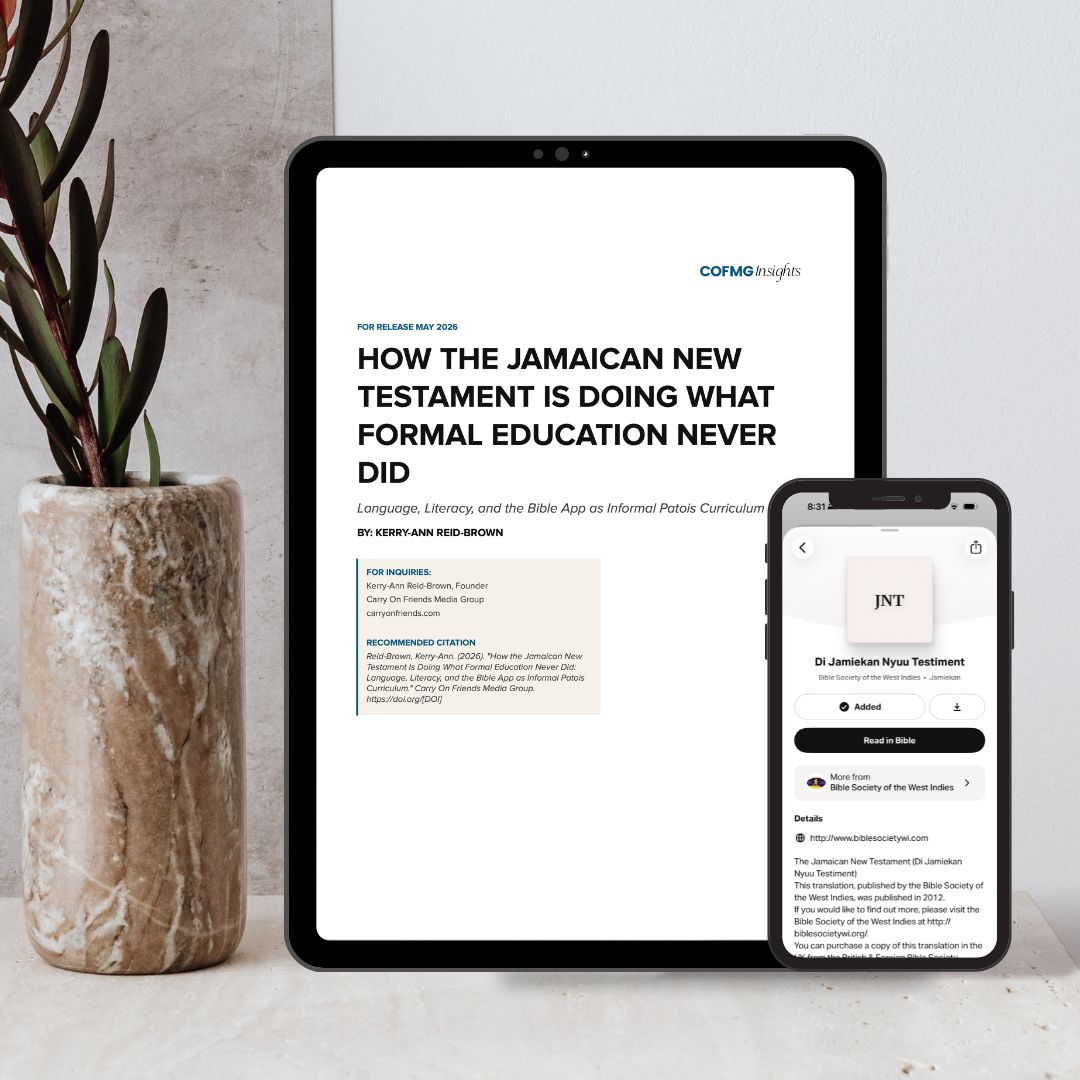
How the Jamaican New Testament Is Doing What Formal Education Never Did
Language, Literacy, and the Bible App as Informal Patois Curriculum
Download the full Brief for FREE
Enter your first name and email to receive the complete Insights Brief as a PDF. You'll also receive updates when new Briefs are published.
Key Findings
The Jamaican New Testament is functioning as an informal Patois literacy curriculum that no formal education system has built.
Most Jamaicans are fluent Patois speakers who were never taught to read or write their language in any standardized form. This is an infrastructure gap, not an intelligence gap.
The Jamaican New Testament on the YouVersion Bible app is functioning as an informal Patois literacy curriculum, one that formal education has never built, language policy has not yet mandated, and the diaspora is discovering on its own.
The current wave of institutional recognition from NYC government to Tech companies is not sudden. It is the acceleration of decades of Jamaican cultural currency, Caribbean migration, and generational shifts in language comfort, now amplified by the creator economy and the second generation carrying the culture forward.
In medical, legal, and professional settings, the absence of language infrastructure costs people their care, their credibility, and their agency. Language erasure is not just cultural loss — it is a justice issue.
Core Argument
Jamaica is a country where faith and language are both foundational to who we are. The Jamaican New Testament brings them together in the same space and in doing so, it may be doing more for Jamaican language literacy than any formal initiative has managed so far.
About the Author

Kerry-Ann Reid-Brown is the founder of Carry On Friends Media Group and host of the Carry On Friends podcast, one of the longest-running Caribbean-American podcasts since 2015. She is the creator of the Caribbean Diaspora Experience Model (CDEM), a six-lens model for understanding how Caribbean people navigate cultural identity in the diaspora, developed from over a decade of podcast conversations, patterns, and lived observation. Her own practice of reading and listening to the Jamaican New Testament in Patois is part of the lived evidence that informs this work.