


Lens 6 of the Caribbean Diaspora Experience Model (CDEM) – You’re Both And
A few months ago I introduced the Caribbean Diaspora Experience Model™ (CDEM), a new way to understand how our Caribbean identity forms, evolves, and expresses itself in the diaspora. Created through real-life experiences, this model provides the language many have been missing to describe their complex cultural journeys. At the heart of CDEM are six interconnected lenses that help individuals understand their relationship with Caribbean culture.
The Six Lenses of CDEM
Here’s a brief overview:
- Where You Start Shapes the Journey: Whether you migrated as an adult or were born in the diaspora, your connection to Caribbean culture starts somewhere. That starting point matters.
- Where You Live + What You Seek = How You Connect: Living in Brooklyn versus Milwaukee isn’t just geography, it’s a different experience of Caribbean culture. Where you live + your intention shapes your connection.
- Cultural Anchors Keep Us Rooted: Food, music, language, celebrations, spirituality, and family. These are the touch points that carry memory and transmit knowledge.
- Your Identity Will Shift, That’s the Point: As we age, our relationship with culture evolves. It’s not loss, it’s recalibration.
- Cultural Identity Influences How We Show Up at Work: Our work ethic, ambition, and how we navigate professional spaces are all shaped by cultural values.
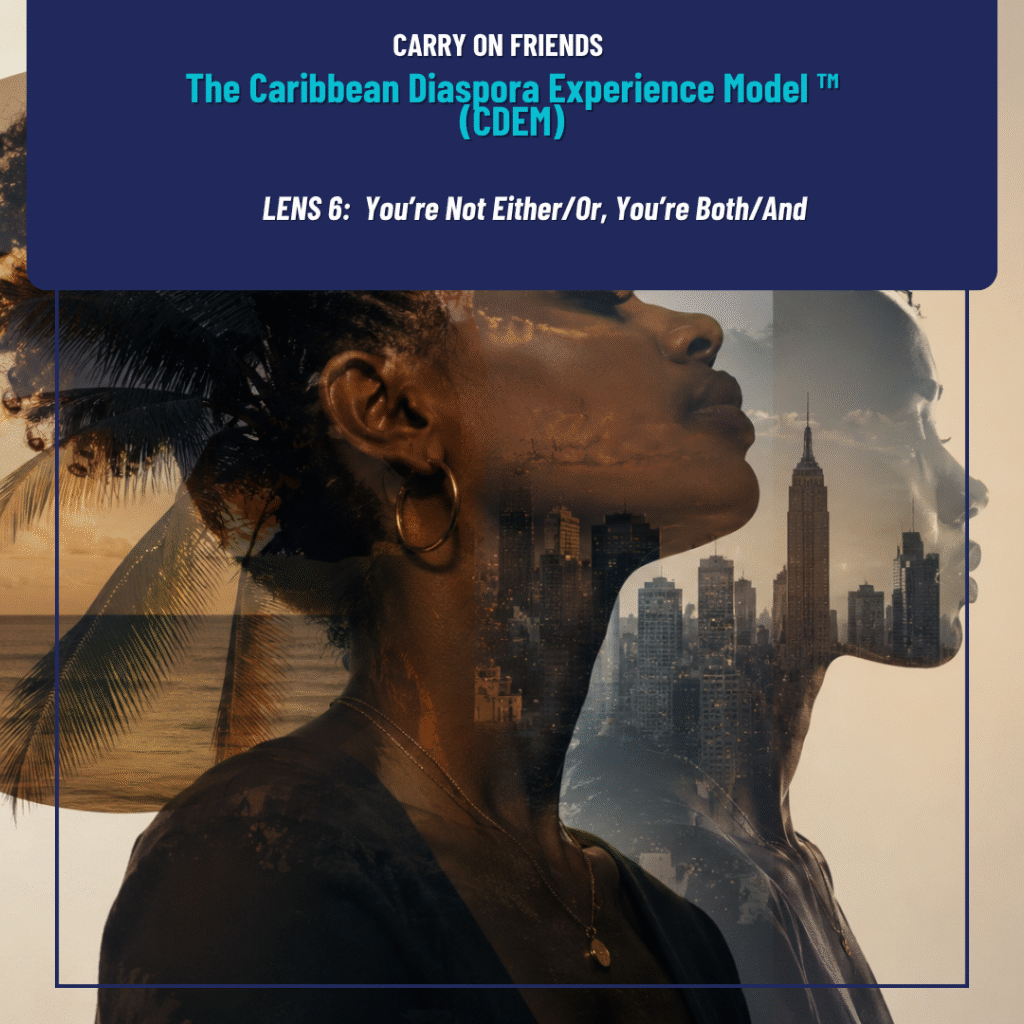
- You’re Not Either/Or, You’re Both/And: Being fully Caribbean and fully American/Canadian/British at the same time is not a contradiction, it’s our strength.
Lens 6: You’re Not Either/Or – You’re Both/And
For many first-generation Caribbean people born in the diaspora, identity can feel like living in the middle of a conversation where everyone else is defining who you are for you. That emotional tension sits at the heart of the latest Carry On Lens 6 of the Caribbean Diaspora Experience Model (CDEM): “You’re Not Either Or, You’re Both And.”
Over more than a decade of hosting conversations about Caribbean identity, one pattern has surfaced repeatedly. People born in places like Brooklyn, Toronto, or Miami often grew up hearing some version of: “You’re not really Jamaican,” “You’re just American,” or “You don’t sound Caribbean.” Yet outside their homes, they were still treated as culturally different because of their food, family traditions, language, or upbringing. For many first-generation Caribbean people, this creates an emotional reality where they feel pressured to constantly prove they belong, in both spaces.
The episode also explores why some immigrant parents intentionally distanced their children from aspects of Caribbean culture. For many families, especially those navigating earlier waves of migration, this wasn’t rejection rooted in shame, but survival rooted in fear. Depending on when and where parents migrated, blending in often felt necessary to protect their children from discrimination, exclusion, or hardship. I approach these decisions with empathy, while also acknowledging the emotional impact many first-generation adults now feel as they try to reconnect to parts of themselves that were muted, hidden, or never fully passed down.
Caribbean identity is not about purity or performance. Being born outside the Caribbean does not erase heritage. Not speaking Patois fluently does not erase lineage. Identity can still be real, layered, and deeply rooted, even when someone’s experience of culture looks different from previous generations. For first-generation Caribbean people especially, identity is often lived in the “both and” space, carrying the culture of home while also belonging to the country where they were raised.
Ultimately, this episode is both a reflection and an affirmation for those navigating diaspora identity. You do not have to choose between identities to honor them. You can be Caribbean and American. Jamaican and Canadian. Guyanese and Brooklyn-born. The goal is not to prove your authenticity to others, but to accept the fullness of who you are.
About Caribbean Diaspora Experience Model (CDEM)
The Caribbean Diaspora Experience Model (CDEM) isn’t an academic theory. It’s a reflection of real-life stories: mine, my family’s, my friends and stories heard through the podcast. It’s grounded in observation, personal growth, and years of conversations in our community.
I created this model not just to help me understand myself, but to help us understand each other better. My hope is that it gives you language to articulate your experience, connect across generations, and build cultural confidence wherever you are in the diaspora.
Stay Connected
Connect with @carryonfriends – Instagram | Facebook | YouTube
Enjoyed the show? Please remember to leave a rating and review in Apple Podcasts.
A Breadfruit Media Production: Instagram
