


Lens 3 of the Caribbean Diaspora Experience Model (CDEM) – Cultural Anchors Keep Us Rooted
A few months ago I introduced the Caribbean Diaspora Experience Model™ (CDEM), a new way to understand how our Caribbean identity forms, evolves, and expresses itself in the diaspora. Created through real-life experiences, this model provides the language many have been missing to describe their complex cultural journeys. At the heart of CDEM are six interconnected lenses that help individuals understand their relationship with Caribbean culture.
The Six Lenses of CDEM
Here’s a brief overview:
- Where You Start Shapes the Journey: Whether you migrated as an adult or were born in the diaspora, your connection to Caribbean culture starts somewhere. That starting point matters.
- Where You Live + What You Seek = How You Connect: Living in Brooklyn versus Milwaukee isn’t just geography, it’s a different experience of Caribbean culture. Where you live + your intention shapes your connection.
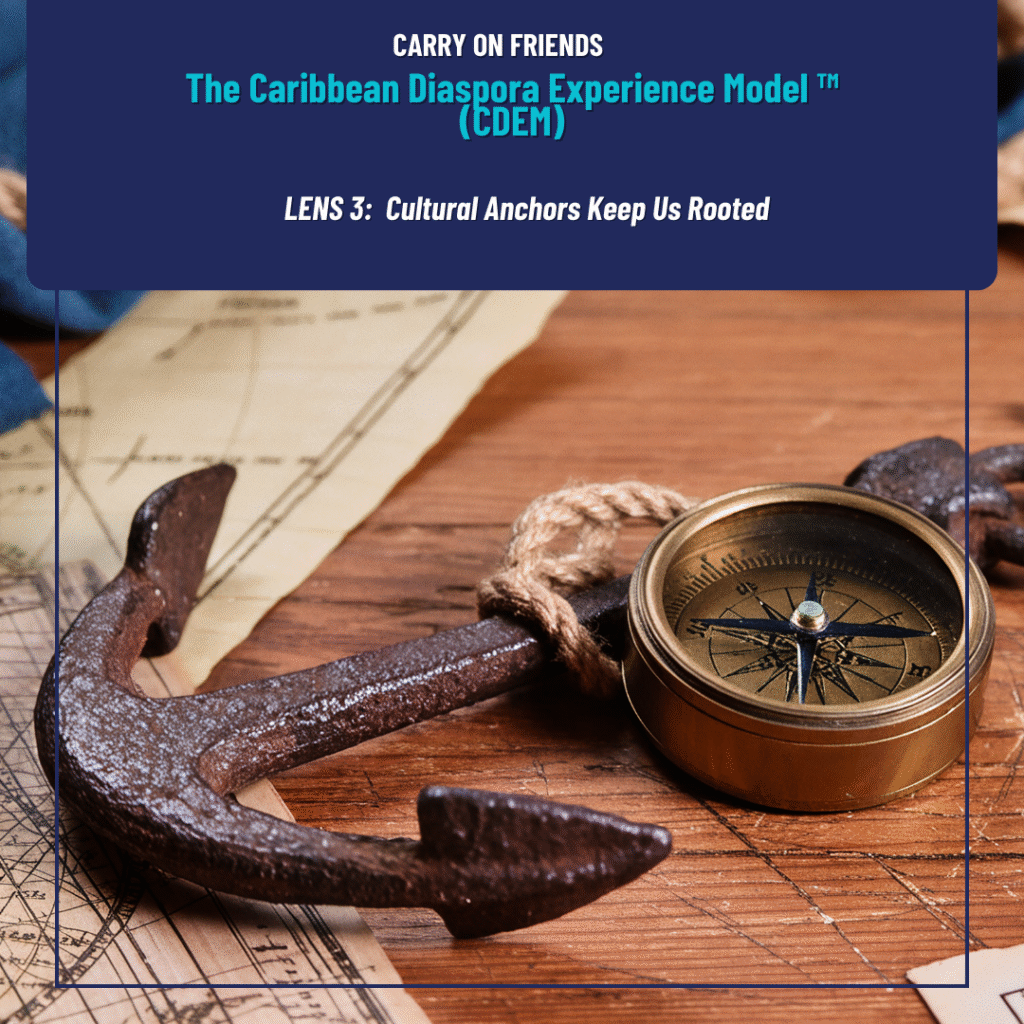
- Cultural Anchors Keep Us Rooted: Food, music, language, celebrations, spirituality, and family. These are the touch points that carry memory and transmit knowledge.
- Your Identity Will Shift, That’s the Point: As we age, our relationship with culture evolves. It’s not loss, it’s recalibration.
- Cultural Identity Influences How We Show Up at Work: Our work ethic, ambition, and how we navigate professional spaces are all shaped by cultural values.
- You’re Not Either/Or, You’re Both/And: Being fully Caribbean and fully American/Canadian/British at the same time is not a contradiction, it’s our strength.
Lens 3: Cultural Anchors Keep Us Rooted
In this episode I dive deeper into Lens 3 of the Caribbean Diaspora Experience Model (CDEM): Cultural Anchors Keep Us Rooted.
Cultural anchors are the tangible elements that ground us in our Caribbean identity, especially when distance, migration, and geography separate us from “home.” For the purposes of this model, I focus on six primary cultural anchors.
- Food practices are often the most visible, from everyday meals like rice and peas to holiday traditions like black cake or soup on Saturdays.
- Music and dance carry memory, and embodied knowledge; sometimes your body remembers before your mind does.
- Language, including dialect, accent, and expressions, becomes a quiet signal that helps us recognize each other in unfamiliar spaces.
- Ceremonial traditions, like funerals, weddings, independence celebrations, and religious observances, carry cultural codes about how we gather and honor life.
- Spiritual practices shape how faith is lived and expressed across generations.
- And finally, family structures, especially extended and intergenerational relationships, define how many of us were raised and how we understand kinship.
These anchors are not symbolic. They work. They function in four key ways:
- First, they create sensory connection. A smell, a song, or a voice can instantly transport you back to a specific place and time.
- Second, they enable knowledge transmission. Music, language, and stories teach younger generations about history, context, and culture, often without formal instruction.
- Third, they support community building. Anchors give us shared reference points that help us find each other and gather, even when we are far from home.
- And fourth, they allow for identity and expression. We get to choose which anchors we express, when, and how, without being “less Caribbean.”
One of the most important insights from this lens is that not all anchors travel equally. Music, food, and language are highly portable. You can cook Caribbean food anywhere, play the music in your car, speak patois on the phone. Other anchors, like Carnival, require infrastructure, organization, and a critical mass of community. Geography matters. If you live in Brooklyn, Toronto, or Miami, you may have access to many anchors at once. In smaller cities, you may lean more heavily on the anchors you can create yourself. This isn’t a deficit. It’s reality.
Cultural anchors also do quiet, everyday work. Bringing Caribbean food to work can spark curiosity, conversation, and connection. It can signal identity to other Caribbean people you didn’t even know were there. It can introduce non-Caribbean coworkers to flavors, stories, and histories they’ve never experienced. In these small moments, culture becomes visible, relational, and alive.
Your Strongest Cultural Anchor
What is your strongest cultural anchor right now? Not the one you think should be strongest, but the one that actually is. How is it functioning in your life? Is it connecting you to memory, helping you grieve, building community, or teaching the next generation? When we name our anchors and understand how they work, we can be more intentional about keeping them active.
Your anchors may look different, but we all have them. And whether we realize it or not, we are all doing the work of keeping Caribbean culture alive across distance and time.
About Caribbean Diaspora Experience Model (CDEM
The Caribbean Diaspora Experience Model (CDEM) isn’t an academic theory. It’s a reflection of real-life stories: mine, my family’s, my friends and stories heard through the podcast. It’s grounded in observation, personal growth, and years of conversations in our community.
I created this model not just to help me understand myself, but to help us understand each other better. My hope is that it gives you language to articulate your experience, connect across generations, and build cultural confidence wherever you are in the diaspora.
Stay Connected
Connect with @carryonfriends – Instagram | Facebook | YouTube
Enjoyed the show? Please remember to leave a rating and review in Apple Podcasts.
A Breadfruit Media Production: Instagram
